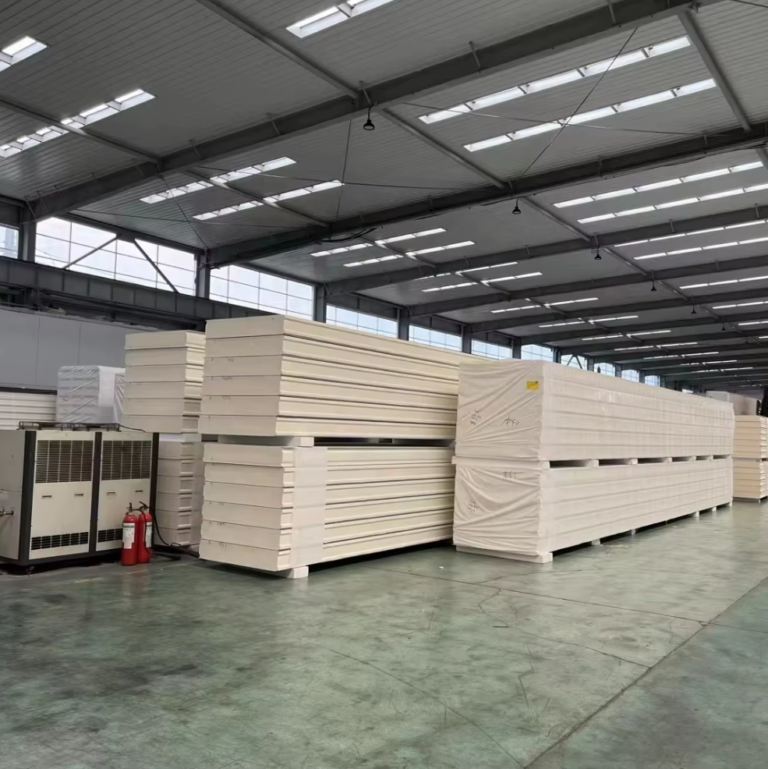
PU Edge Rock Wool Sandwich Panels
PU edge rock wool sandwich panels have become an essential component in modern construction, balancing fire safety, energy efficiency, and durability. These panels combine a rock wool core with PU edge sealing to address common performance challenges associated with traditional rock wool sandwich panels.
Understanding Rock Wool Sandwich Panels
Rock wool sandwich panels consist of a layer of rock wool insulation core sandwiched between two metal facings, typically galvanized or color-coated steel. Rock wool itself is produced from natural rock and mineral materials melted and spun into fibers that provide excellent fire resistance and thermal performance. The rock wool core’s thermal conductivity typically ranges around 0.035–0.043 W/m·K.
One of the most notable benefits of rock wool panels is their fire performance. Rock wool is classified as non-combustible material Class A withstanding temperatures above 1000°C without contributing to flame spread, making it highly suitable for structures with stringent fire safety requirements.

In addition to thermal insulation, the acoustic performance of rock wool is superior to many alternative core materials. With typical sound insulation performance reaching RW = 29–30 dB for panels with 120 kg/m³ density cores, rock wool panels help create quieter interiors in industrial and commercial environments.
Challenge of Rock Wool Sandwich Panels
Despite these strengths, rock wool sandwich panels also present challenges. Their fibrous structure and natural porosity can make them vulnerable to moisture infiltration if edges are not properly sealed.
Exposure to humidity, rock wool can absorb water, which reduces insulation values and may lead to mold growth. This limitation motivates enhancements such as edge sealing and improved joint design.
Besides, rock wool sandwich panels also have other disadvantages. For example, higher weight compared to some foam cores, increasing structural loads and transport costs.

Thermal conductivity is generally higher than premium closed-cell foams like polyurethane. It means that thicker panels are often needed to achieve equivalent insulation performance.
These drawbacks do not negate the value of rock wool panels, but designers and builders must address these disadvantages.
Solutions and the Role of PU Edge Sealing Technology
To address limitations of standard rock wool sandwich panels, manufacturers and engineers implement a series of practical solutions:
Joint design improvements. By installing metal baffles on both sides of the sandwich panel. The baffles and the panels form a structurally integral structure through tongue-and-groove joints, improving the air tightness of the rock wool core.
Edge sealing with polyurethane. Applying PU along the panel edges creates a continuous barrier that significantly reduces moisture ingress, air leakage, and dust penetration. This also minimizes thermal bridging and protects the rock wool core from environmental damage.

These methods can solve the problems faced by traditional rock wool panels, but there are also differences. Due to the physical properties of the rock wool core material, there are still a large number of voids inside the rock wool sandwich panel with metal baffles. Especially for rock wool roof panels, this defect is more obvious.
Industry data on PU edge panels show measurable improvements in performance metrics. For example, edge-sealed rock wool panels maintain sound insulation values ≥30 dB and Class A fire ratings, while the edge seal protects the core from moisture over long service cycles.
Builders frequently combine these strategies with rigorous installation practices, ensuring that panels are properly aligned, sealed, and integrated with flashings and vapor barriers to maximize performance outcomes over decades of use.

How PU Edge Rock Wool Sandwich Panels Work and Their Advantages
PU edge rock wool sandwich panels differentiate themselves through targeted engineering at critical panel interfaces. The core structure integrates rock wool with polyurethane edge sealing material applied at all panel edges. Polyurethane, known for high adhesion and elasticity, forms a durable bond between the metal skins and insulation core, effectively protecting vulnerable zones.
The PU edge serves several critical functions:
Moisture prevention. PU edge acts as a hydrophobic seal that prevents water penetration. Rock wool alone is prone to moisture uptake, so the polyurethane barrier materially reduces this risk.
Improved thermal performance. By reducing air infiltration and thermal bridging at panel joints, the overall thermal resistance of an assembly is enhanced relative to unsealed alternatives.

Mechanical reinforcement. The process of edge banding with polyurethane can not only improve the air tightness of the core material, but also strengthen the rock wool block on the side, effectively reducing the shedding of the edge part. The edge seal contributes to panel stiffness, helping resist deformation under load and enhancing wind-uplift resistance.
These features support typical performance metrics cited by manufacturers. For example, panels with 100 mm core thickness often show heat conductivity values around 0.41 W/m²·K, balancing insulation with structural weight.
Compared with rock wool panels without edge sealing, PU edge panels often deliver longer service life , more than 15 years, reduced maintenance issues, and improved moisture resistance in humid or coastal environments. These characteristics make PU edge rock wool sandwich panels particularly well suited for industrial facilities, cold chain buildings, airports, sports venues, and commercial complexes where long-term performance and safety are priorities.
Share this content: