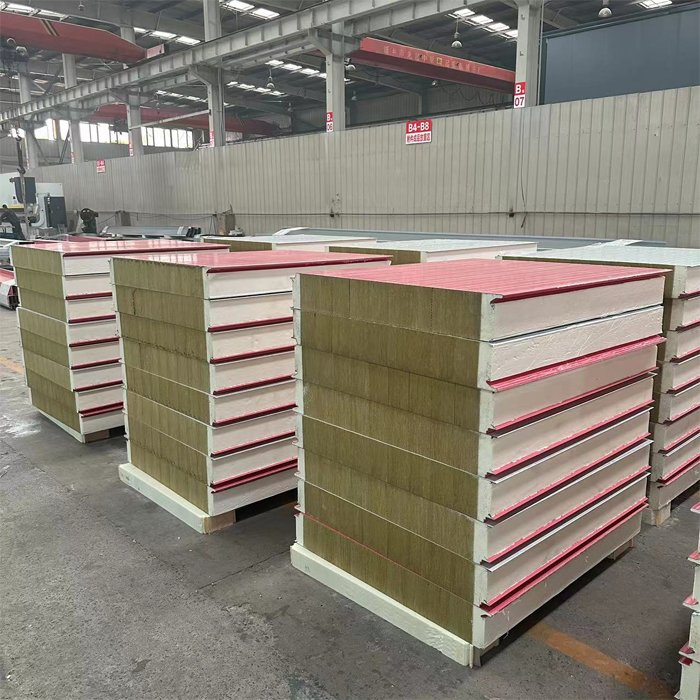
How cold storage panels are produced?
Cold storage panels act as core components of cold chain logistics and directly influence storage quality for food and pharmaceuticals. Perishable goods demand stable temperature control throughout storage and transportation. A qualified cold storage panel must resist extreme cold at −30 °C without losing performance. The panel must also maintain stability in humid environments over long service periods.
Understanding the manufacturing process helps buyers choose suitable products and reliable suppliers. This knowledge also reduces project risks and long-term operating costs. Manufacturers produce cold storage panels through several key steps.
These steps include metal panel forming, adhesive spraying, and foam material injection. The process continues with core material foaming, panel cutting, curing, and final inspection. Each step affects panel strength, insulation efficiency, and service life. Manufacturers must control every stage to ensure consistent product quality.

Material Selection for Cold Storage Panels
Metal panel quality deserves primary attention. Metal panels serve as the structural skeleton of cold storage panels. They directly determine overall strength and dimensional stability. The mainstream choice uses high-quality color steel panels with 0.5 mm thickness. Manufacturers coat these panels with polyester resin for corrosion resistance. The coating also protects panels from impact damage during transport and installation.
Some small suppliers lower prices by cutting material costs. They often use metal panels with thickness around 0.3 mm. Such panels deform easily under load or temperature changes. Deformation increases maintenance frequency and repair expenses. Lower initial prices often lead to higher long-term costs.

Quality suppliers apply stricter material standards. Just like Harbin Dongan Building Sheets uses metal panels between 0.4 and 0.8 mm thick. The zinc coating weight reaches at least 120 g/m² on both sides. This specification prevents corrosion for more than ten years. Thicker panels also improve impact resistance and structural rigidity. These advantages support long-term cold storage operations.
Core material quality plays an equally critical role. The core determines insulation performance and energy efficiency. High-pressure polyurethane foam dominates the modern cold storage market. Its thermal conductivity remains at or below 0.024 W/(m·K). Low conductivity reduces heat transfer and energy loss.
Quality manufacturers carefully control foam density. Dongan maintains polyurethane density between 38 and 42 kg/m³. This range balances insulation efficiency and mechanical strength. Lower density weakens structure, while higher density reduces insulation efficiency. Proper density control ensures stable performance under load.

Foaming agents also influence insulation quality. Manufacturers should choose high-quality agents such as HCFC-141B. Premium agents create uniform foam cells and high closed-cell rates. Uniform cells improve thermal resistance and moisture resistance. This choice supports long-term insulation stability.
Production Process of Cold Storage Panels
Automated production lines enable precise process control. Modern manufacturing demands extremely accurate material ratios. Automated continuous lines meet these requirements effectively. The market increasingly favors automated cold storage panel production.
Computer systems control foaming temperature, pressure, and reaction time. These systems maintain stable conditions throughout production. Raw materials foam consistently at approximately 38 °C. Stable temperature improves foam structure and bonding performance. The closed-cell rate reaches at least 95 percent after foaming.

Automated foaming offers clear advantages over manual processes. Traditional manual foaming creates uneven density and weak spots. Automated foaming produces uniform cores across each panel. Thermal conductivity variation remains below 0.002 W/(m·K). Consistent insulation improves overall cold room efficiency.
High-quality panels reduce operational energy consumption after installation. Users typically save 15 to 20 percent on energy costs. Lower energy demand improves project economics and sustainability. Stable insulation also protects stored goods more effectively.
Bonding quality ensures long service life. Panel structure requires strong adhesion between metal skins and core material. Bonding strength directly affects durability and safety. Many cold storage failures occur due to panel delamination. Metal skins separate when bonding strength proves insufficient.

Manufacturers must ensure adequate bonding strength. Bonding strength should exceed 1.0 kg/cm². Each square meter panel should withstand one ton of tensile force. These standards prevent separation under thermal stress.
Dongan uses high-quality two-component polyurethane adhesive. This adhesive provides strong and durable bonding performance. New panels cure at 70 °C for 24 hours. Curing allows the adhesive to reach optimal strength. This process prevents delamination during extreme temperature changes.
Strict Quality Monitoring
Strict quality monitoring supports reliable product performance. Appearance inspection represents the first quality control step. Dongan enforces rigorous visual inspection standards. Panel surfaces must remain free of visible defects.

Surface unevenness must stay below 1.5 mm. Scratch depth must not exceed 0.2 mm. Diagonal deviation must remain under 2 mm. These standards ensure precise installation and tight panel joints. Good appearance also reflects internal manufacturing quality.
Strict inspection ensures stable long-term performance. Customers benefit from reduced maintenance and improved reliability. High standards also protect brand reputation and customer trust.
Performance testing forms the final quality control stage. Every production batch undergoes comprehensive testing. Panels freeze at −30 °C for 24 hours. Technicians then move panels immediately to a 60 °C environment. Inspectors observe cracking, deformation, or delamination.

This thermal shock test simulates extreme operating conditions. Panels must maintain integrity during rapid temperature changes. Successful testing confirms material selection and process control effectiveness. Only qualified panels reach the market.
Through strict material selection, precise production, and rigorous testing, manufacturers ensure reliable cold storage panels. High-quality panels protect goods, reduce energy consumption, and support long-term cold chain operations.
Share this content: