

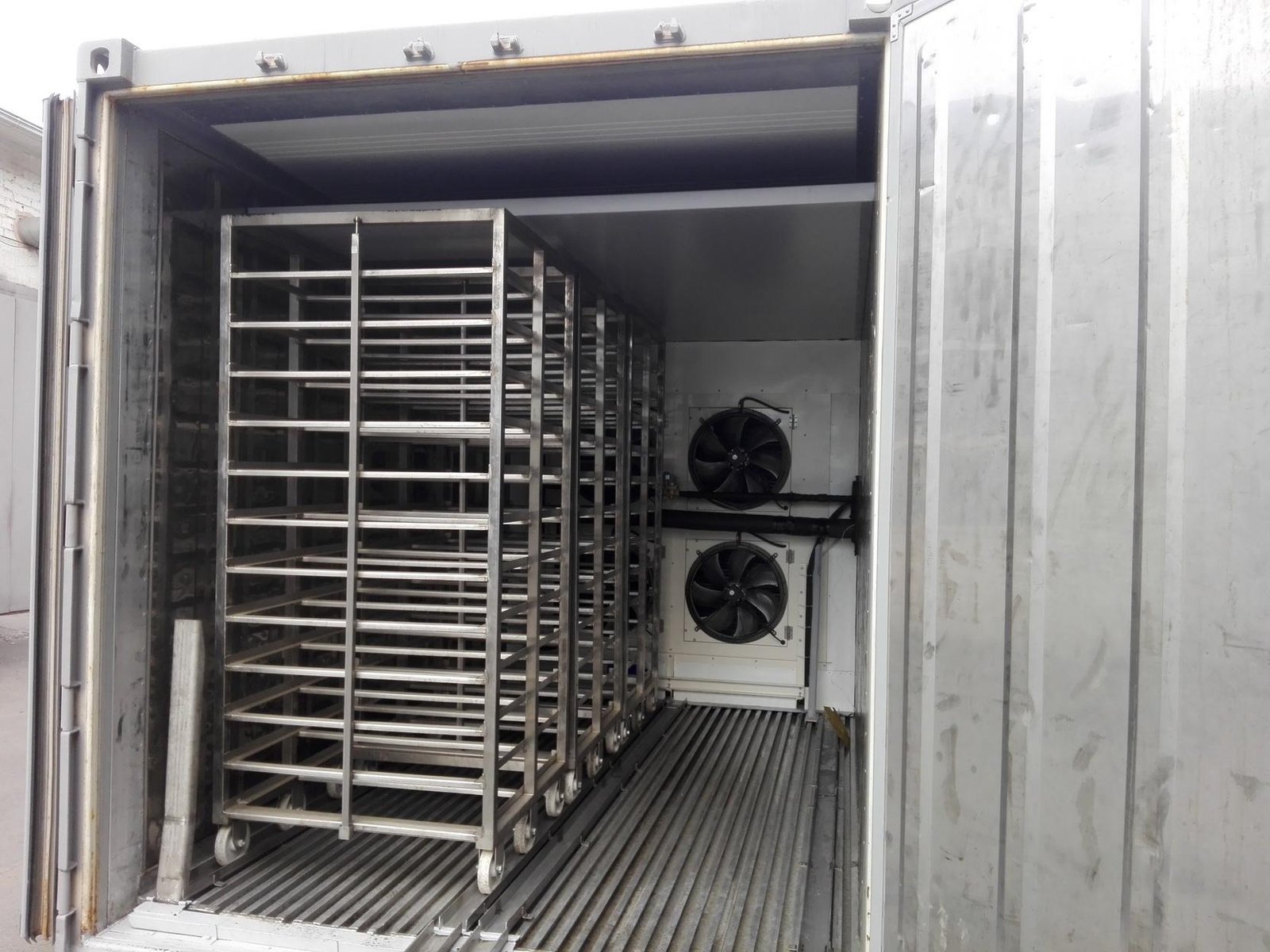
Quick Freezing Cold Room for Rapid Food Preservation
A quick freezing cold room rapidly reduces product temperature. It protects food quality and structure. Many industries use it for meat, seafood, and vegetables. The room lowers core temperature fast. Most systems freeze products from +20°C to –18°C quickly. The freezing time often stays under 4 hours. Rapid freezing limits ice crystal growth. Small crystals protect cell structure. This process preserves taste, color, and nutrition. Many factories install quick-freezing rooms in processing lines. The room supports high throughput and stable quality. Food producers rely on this system for export and long storage.
Temperature Range and Freezing Performance of Quick Freezing Cold Room
The cooling temperature of quick-freezing cold room is generally -15~-35℃, which is similar to that of low-temperature cold storage. The main difference between quick-freezing cold storage and low-temperature cold storage is the freezing speed. Compared with ordinary cold room, quick-freezing cold room can quickly reduce the core temperature of items, allowing them to quickly pass through the maximum ice crystal generation area.

When freezing, most of the moisture inside the food freezes at -1~-5℃. Therefore, -1~-5℃ is also called the maximum ice crystal generation zone. In the process of freezing into ice, the volume of water will become larger, and the internal structure of many foods, and even the form of protein, will be irreversible.
The longer the core temperature of the food stays in the maximum ice crystal formation area, the more ice crystals will be inside, and the more serious the food will be destroyed. Food will lose its firm taste, and its original flavor will also be lost. This is all caused by inappropriate freezing methods. Quick freezing cold room has changed the cooling method that used to slowly lower the core temperature of items, using a large amount of cold air in multiple directions to quickly pass the core temperature of items through the maximum ice crystal generation area.
In this way, only large ice crystals will be produced on the outside, and the inside will still be well preserved. Therefore, food stored in quick-freezing cold room can retain its original structure to the maximum extent, and generally have a better taste and flavor.

Key Structural Characteristics of Quick Freezing Cold Room
A quick freezing cold room uses heavy insulation. Panel thickness usually reaches 120 mm to 150 mm. PU panels offer thermal conductivity around 0.022 W/m·K. PIR panels improve fire resistance. The room structure includes reinforced floors. Floors handle loads of 2,000 to 5,000 kg/m². Anti-slip aluminum or stainless steel surfaces support safety.
Doors use heated frames. Door heaters consume about 60 to 120 watts. These heaters prevent ice buildup. Tight seals reduce air leakage. The room size varies by production scale. Small rooms measure 20 m². Large industrial rooms exceed 300 m². Ceiling height usually ranges from 3 m to 6 m. Strong structure reduces heat gain by over 25%. This insulation allows stable operation under extreme temperature differences.
Refrigeration System and Components of Quick Freezing Cold Room

The refrigeration system forms the core of quick freezing performance, especially for quick freezing cold room. The temperature change curve in the quick-freezing cold room is not decreasing slowly. Instead, it drops to -40 ℃ rapidly, then gradually recovers, and finally controls the temperature at -18 ℃. Therefore, quick-freezing cold room often installs higher-power refrigeration equipment.
Most systems use screw or semi-hermetic compressors. Screw compressors suit capacities above 50 kW. Cooling capacity remains high. A 50 m² quick-freezing room often needs 40 to 60 kW. A 200 m² room may require 150 to 250 kW.
The system includes evaporators, condensers, expansion valves, and oil separators. Evaporators use wide fin spacing. Fin spacing usually measures 8 mm to 12 mm. This design prevents frost blockage.

Refrigerants include R404A, R507A, and ammonia. Ammonia systems reach high efficiency. Ammonia systems reduce energy use by 15% to 20%. Fans inside evaporators deliver strong airflow. Air velocity often reaches 3 to 6 m/s. High airflow removes surface heat fast. This system ensures rapid and uniform freezing.
Airflow Design and Product Freezing Quality
Airflow defines freezing efficiency. Quick-freezing cold rooms use forced convection. Fans push cold air directly over products. Typical airflow volume ranges from 20,000 to 40,000 m³/h. Air velocity around products stays consistent. Uniform airflow prevents uneven freezing.
Product spacing also matters. Trays usually keep 30 to 50 mm gaps. This spacing allows air circulation. Good spacing shortens freezing time by 20%. The system freezes products evenly. Core temperature reaches –18°C quickly. Uneven freezing causes texture damage. Strong airflow prevents this risk. Air deflectors guide airflow direction. These deflectors reduce dead zones. The airflow system ensures stable freezing quality for every batch.

Applications Across Food Industries
Quick freezing cold rooms serve many industries. Seafood processors freeze shrimp, fish, and squid. Many plants process 2 to 10 tons daily. Meat processors freeze beef, pork, and poultry. Vegetable processors freeze peas, corn, and berries. Ready-meal factories freeze prepared dishes. Portion control and fast freezing preserve structure.
Cold chain logistics centers use quick-freezing rooms before storage. This step stabilizes products before long transport. The wide application range shows the system’s industrial importance.

Control Systems and Automation
Modern quick freezing cold rooms use intelligent control systems. PLC controllers manage temperature and airflow. Sensors monitor temperature, pressure, and fan speed. Temperature accuracy stays within ±1°C. Touch screens display real-time data. Operators adjust settings easily. Alarms activate within 5 seconds during faults.
Automation reduces labor needs. One operator may manage multiple rooms. Data storage supports quality audits. Remote monitoring allows off-site supervision. These systems increase reliability and reduce operational risk.
Share this content:


